There is one sentence in the Department for Education’s new allergy guidance that should make every head teacher stop and check their training records:
“First aid training is not sufficient.”Department for Education, Allergy safety in schools, statutory guidance, July 2026
If your staff learned to use an adrenaline auto-injector as part of a first aid course, that on its own no longer meets what the government expects. This article explains what Benedict’s Law requires, who it applies to, and the practical steps schools in Gloucestershire can take this term.
What is Benedict’s Law?
Benedict’s Law is named after Benedict Blythe, who was five years old when he died from anaphylaxis at school in 2021. His family’s campaign led to new duties for schools in England, set out in section 34 of the Children’s Wellbeing and Schools Act 2026.
The Department for Education published the statutory guidance, Allergy safety in schools, on 6 July 2026 and updated it on 24 September 2026. Local authority briefings, such as Hampshire’s, confirm that it became mandatory from September 2026.
Which schools does it apply to?
The guidance is statutory for:
- local authority maintained schools, including special schools (but not maintained nursery schools)
- academies and free schools, including alternative provision academies (but not 16 to 19 academies)
- pupil referral units
Independent schools and non-maintained special schools are not covered yet. The government says it intends to bring in equivalent requirements for them through their regulatory standards, so it makes sense to prepare now.
Nurseries and other early years settings should keep following the Early Years Foundation Stage (EYFS) statutory framework. The DfE suggests the allergy guidance may still be useful to them as good practice.
What schools must now do
| Requirement | What the guidance says |
|---|---|
| Allergy safety policy | Every school must have an allergy safety policy and publish it. The DfE provides a template. |
| Staff training | All staff present while pupils are on site should receive allergy awareness training, at least once a year. |
| Individual healthcare plans | Identify pupils whose allergy needs an individual healthcare plan, and write one for each. |
| Spare adrenaline auto-injectors | The DfE expects all schools to stock spare auto-injectors of the correct dosage for their pupils, kept in pairs. |
| Incidents and near misses | Record serious incidents and near misses, and learn from them. |
Who needs training?
The guidance is broad on purpose. It covers permanent, temporary, supply, peripatetic and agency staff, regular volunteers, catering staff, and breakfast and after-school club staff. Contractors with no contact with pupils are not included. In practice, that means the lunchtime supervisor and the supply teacher covering Year 2 need the same awareness as the class teacher.
What must the training cover?
According to the guidance, allergy awareness training should include:
- types of allergy and conditions that often occur alongside them
- the difference between an allergy, coeliac disease and a food intolerance
- how to recognise anaphylaxis
- how to respond in an emergency
- how to use adrenaline auto-injectors and asthma reliever inhalers
- how to report incidents and near misses
This is why a general first aid course is not enough on its own. Anaphylaxis is covered in first aid training, but the guidance asks for a wider understanding of allergy in a school setting, refreshed every year.
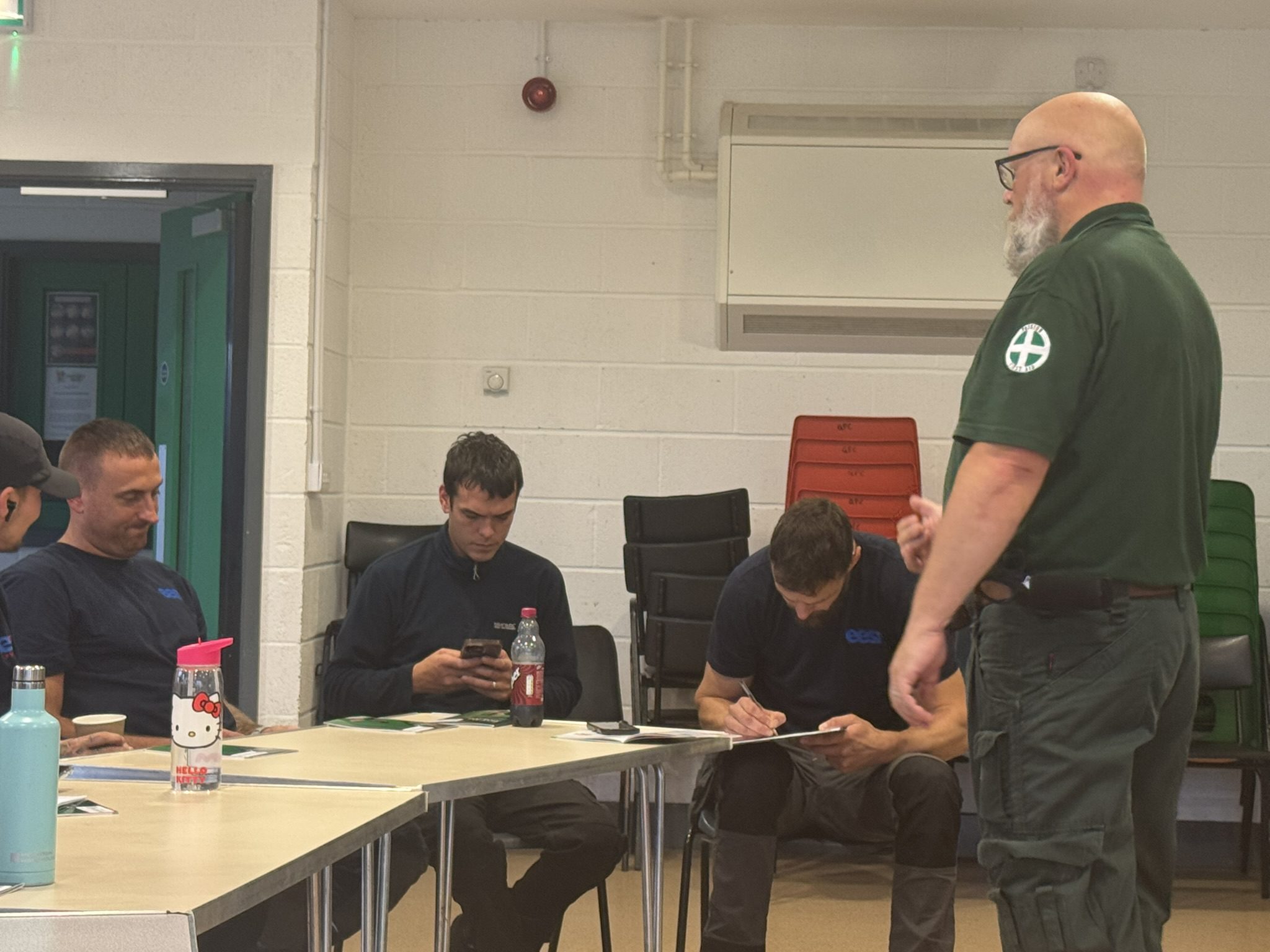
Need to train your whole staff team? Our Level 2 Basic Life Support and Management of Anaphylaxis course covers every topic on the DfE’s list. We deliver it at your school in a three-hour session for up to 12 staff.
Spare auto-injectors: what has changed
Schools in England have been allowed to buy spare adrenaline auto-injectors without a prescription since 1 October 2017. What was optional is now expected. The new guidance says:
- spares should always be stocked and stored in pairs
- a primary or special school would typically need one pair of 150 microgram devices and, where pupils need them, one pair of 300 microgram devices
- a secondary school would typically need one or two pairs of 300 microgram devices
- only auto-injectors can be held as spares, not nasal adrenaline
Spares are a back-up for pupils at risk whose own device is unavailable or not working. They do not replace each pupil’s own prescribed devices. The government intends to make stocking spares a legal duty through future regulations.
Early years settings and further education colleges are not permitted to stock spare devices under this guidance.
A practical checklist for this term
- Name a lead. Give one senior member of staff responsibility for allergy safety. Hampshire County Council’s briefing suggests also asking a governor to oversee it.
- Publish your policy. Start from the DfE template and adapt it to your site, catering arrangements and trips.
- Update healthcare plans. Check which pupils need an individual healthcare plan and that each plan is current.
- Book annual training for everyone. Include supply staff, kitchen staff, volunteers and club staff, and keep a record of who has attended.
- Check your spare auto-injectors. Make sure they are in pairs, the right dose for your pupils, in date, and easy to reach quickly.
- Set up near-miss reporting. Make it easy for staff to log an incident or a near miss, and review the log when you review your policy.
Frequently asked questions
Does Benedict’s Law apply to independent schools?
Not yet. The statutory guidance covers maintained schools, academies and pupil referral units. The government intends to introduce equivalent requirements for independent and non-maintained special schools through their regulatory standards.
Is a first aid certificate enough?
No. The guidance states that first aid training is not sufficient. Staff need allergy awareness training that covers recognising anaphylaxis, the emergency response, using auto-injectors and inhalers, and reporting incidents.
How often does allergy training need to happen?
At least once a year for all staff present while pupils are on site. A qualification may be valid for longer, but you should still plan a refresher every year.
Can nurseries keep spare adrenaline auto-injectors?
No. Under the guidance, early years settings and further education colleges are not permitted to stock spare devices. Nurseries should continue to follow the EYFS framework.
Can you train our staff at our school?
Yes. We deliver the anaphylaxis course on site for groups of up to 12 staff, so you can fit it around the school day.
Get your whole staff team allergy-ready
We train school staff across Gloucestershire at their own school, in one three-hour session for up to 12 people. Every topic on the DfE’s training list is covered, including how to use an auto-injector.
Prefer to talk it through? Call Jim on 07811 025169 or email enquiries@passionfirstaid.co.uk.
Sources
- Department for Education, Allergy safety in schools (published 6 July 2026, updated 24 September 2026)
- Department of Health and Social Care, Using emergency adrenaline auto-injectors in schools (20 September 2017)
- Allergy UK, Benedict’s Law (updated 9 March 2026)
- Hampshire County Council, Benedict’s Law briefing for schools (July 2026)